
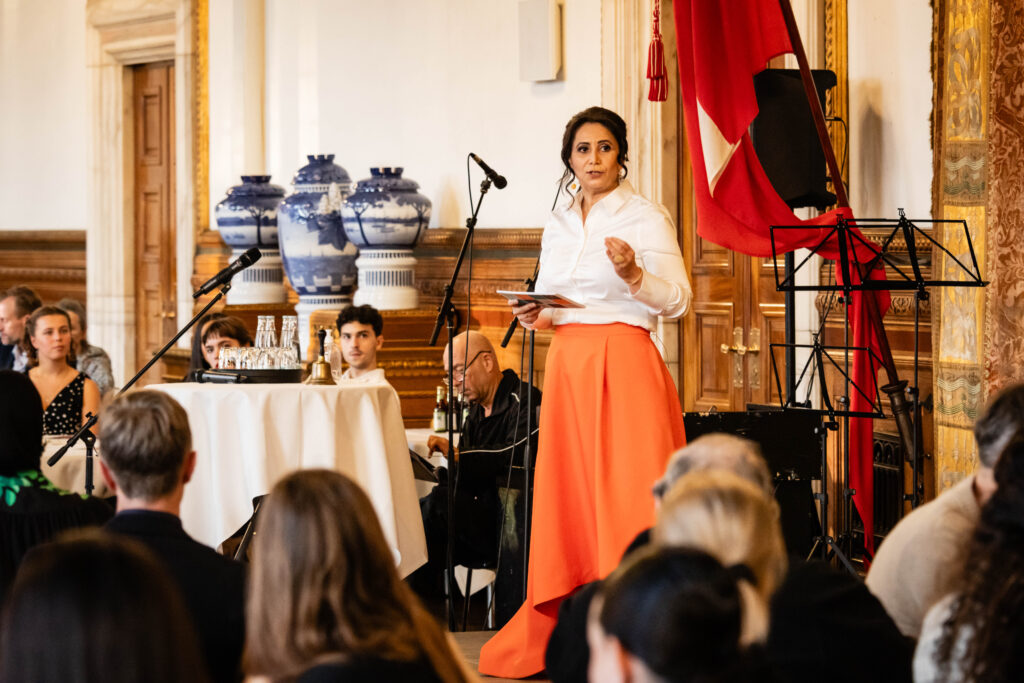
Özlem's speech at the Ramadan dinner
Speech at Ramadan dinner at Copenhagen City Hall on March 19, 2025
THE SPOKEN WORD COUNTS
The first time I held a Ramadan dinner in the Danish Parliament in 2010, PET called to ask if extra security was needed, as the participants might cause trouble.
Some people even thought that you were circumcised on your way to dinner!
During the coronavirus pandemic, our virtual dinner was hacked by right-wing extremists, with over 1,000 guests witnessing a child being sexually abused.
There have been many amusing – and some less amusing – attempts over the years to prevent people from eating hummus together.
But when I look back, there is one word that characterizes the resistance to meeting across differences and despite disagreements: legitimization.
The mantra is that if you meet your opposite, you help to "legitimize" the other. Legitimize Islam. Legitimize headscarves. Legitimize Muslims.
I have never understood this kind of logic, even though I recognize that encountering someone who holds opposing views can really challenge one's tolerance. The prerequisite for a well-functioning democracy is that we can talk to each other – despite our differences. Because opponents are also fellow human beings. They are fellow citizens and fellow countrymen. They are neighbors, colleagues, volunteers, and friends.
The essence of the Ramadan dinner is to bring people together so that they can learn more about each other's beliefs, customs, and traditions. It is not an attempt to sneak my religion in through the back door or forcibly convert my guests along the way.
Therefore, I would like to reassure you. We have not put anything in the food. You will leave here exactly as you were and are – but perhaps with new acquaintances in your cell phone's address book.
The ticket to a Ramadan dinner is not consensus, but diversity. That is why we have sent out invitations to a wide range of people. All parties in the Danish Parliament have received invitations. Organizations and individuals who are traditionally more critical of Islam have also been invited.
And it is a great honor for us that so many different people have agreed to meet across differences.
For the same reason, you will not be seated with your partners or friends. You can rest assured that we have had a lot of fun with the seating plan at Brobyggerne. We have made every effort to seat you as diversely as possible. Jewish friends are seated with Muslim friends. Researchers are seated with practitioners. Actors with lawyers. Kurds with Turks. Greenlanders with Americans. I could go on.
But when I look out over the assembly, it is especially the guests sitting at three particular tables that I am particularly happy to see. It is you young people who have chosen to spend an evening in this company. Thank you for giving us adults hope for the future. It's great to have you here.
For us Muslims, Ramadan is a month of diversity, where we meet across boundaries, where there is freedom for difference, and where there is room for everyone – regardless of ethnic, religious, economic, and cultural background.
Ramadan is a month for reflection. It is a time to pause and consider whether you have hurt anyone along the way. It is a time for solidarity and a call to reach out to those who are less fortunate than yourself.
It is also a time when families and friends come together to deepen their faith, engage in their communities, and remind each other of the importance of compassion.
I think that all of us, regardless of our beliefs, can agree that it is always good to reflect on this.
And we would do well to reflect on the fact that minorities in Denmark actually contribute to creating a dynamic and diverse society. They have lived in Denmark for several generations. They represent countless ethnicities and have roots in many different parts of the world.
Many came in their time to try to create a better future for their children. My father was one of them. He came with the dream of saving money to buy 40 sheep and a house in the village. He worked hard like everyone else to realize his dream.
The first generation worked in factories, in agriculture, and in all the places where there was a shortage of labor. In this way, they helped build our Denmark.
Today, the new generation is active in all areas of society. They respond as police officers when there is unrest on the streets, they extinguish fires in our buildings as firefighters, and they keep us healthy as doctors, nurses, and dental hygienists. They are involved in cancer treatment research. They clean your computer of viruses and they clean our offices, care for our elderly, and raise our children in institutions. They are active in politics, in the media, and in finance. We are part of Denmark, and the vast majority proudly contribute to the community.
Tonight, we see only a small sample of these contributions. I would like to extend a special welcome to the minorities from many walks of life who have gathered here today.
Our Denmark is a country made up of Christians and Muslims, Jews and Hindus, Buddhists, Alevis, and atheists. And the purpose of tonight is to celebrate diversity.
Therefore, it is in the spirit of diversity and reflection that I welcome you to this iftar.